

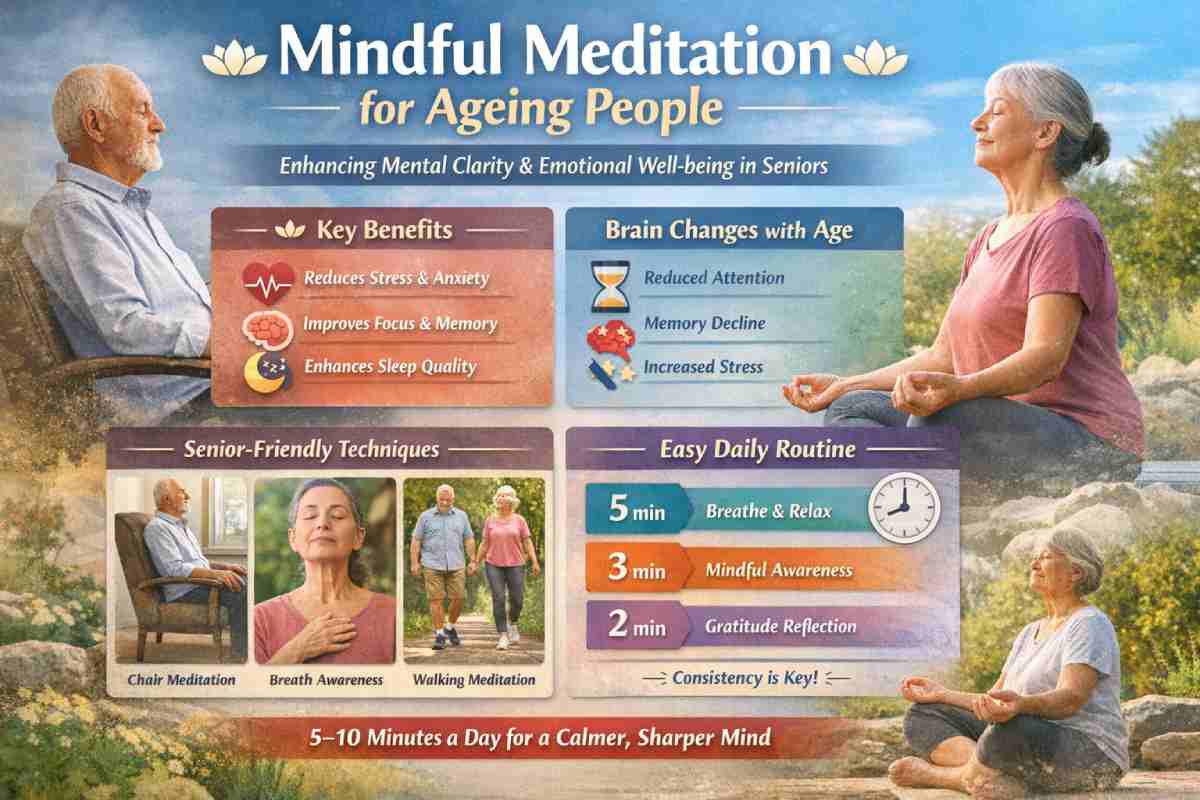
Mindful meditation is more than a relaxation tool for older adults—it can act as a daily brain-maintenance habit that supports emotional resilience, cognitive clarity, and healthier aging.
Many people notice subtle mental changes as they grow older. Attention may wander more easily. Stress can feel harder to manage. Sleep sometimes becomes lighter and less restorative. These shifts are normal parts of aging, but they can affect quality of life.
Mindful meditation offers a practical response to these challenges. Instead of trying to “stop thinking,” mindfulness trains the brain to notice thoughts calmly and bring attention back to the present moment.
Research suggests this habit can support emotional stability, sleep quality, and attention in older adults. For example, clinical research published in JAMA Internal Medicine found that mindfulness meditation helped improve sleep quality and reduce daytime fatigue in older adults experiencing sleep disturbances.
Similarly, cognitive studies have found mindfulness training can improve attention and long-term memory in people over 50.
The most important takeaway is simple:
Mindful meditation does not require long sessions or complex techniques. A few minutes of consistent practice each day can help maintain mental clarity and emotional balance as we age.
Why Mindful Meditation Matters More as We Age
Aging affects both body and mind. While physical changes are often obvious, mental shifts are sometimes more subtle.
Older adults commonly experience:
-
increased stress related to life changes
-
shifts in attention or memory
-
changes in sleep patterns
-
emotional challenges such as loneliness or grief
Mindfulness meditation directly addresses these areas by strengthening the brain’s ability to stay focused and calm.
Researchers studying mindfulness and aging describe meditation as a mental training practice, similar to how physical exercise maintains muscle strength.
Common Mental Challenges in Aging
| Challenge | Why It Happens | How Meditation Helps |
|---|---|---|
| Reduced attention | Aging brain processes information differently | Mindfulness trains focus and attention control |
| Emotional stress | Life transitions such as retirement or health issues | Meditation improves emotional regulation |
| Poor sleep | Changes in circadian rhythm | Relaxation response promotes better sleep |
| Loneliness | Social routines may shrink | Meditation increases emotional resilience |
Research from Harvard Health Publishing shows that mindfulness practices can improve sustained attention and alter brain activity linked to focus.
In other words, meditation doesn’t stop aging—but it helps the brain adapt more effectively.
What Is Mindful Meditation? (Simple Explanation)
Mindful meditation is the practice of paying attention to the present moment without judgment.
Instead of constantly thinking about the past or future, mindfulness trains the mind to focus on what is happening right now.
Core Elements of Mindfulness
| Element | Description |
|---|---|
| Awareness | Noticing thoughts, feelings, and sensations |
| Acceptance | Observing experiences without judging them |
| Attention | Gently bringing focus back when the mind wanders |
Most mindfulness practices use breathing as an anchor because breathing is always present and easy to observe.
Simple Mindfulness Process
| Step | What To Do |
|---|---|
| 1 | Sit comfortably and close your eyes if you wish |
| 2 | Focus attention on breathing |
| 3 | Notice when the mind wanders |
| 4 | Gently return attention to the breath |
This process may sound simple, but repeating it regularly strengthens the brain’s attention networks.
How Aging Changes the Brain—and Why Meditation Helps
The brain continues to change throughout life. Scientists call this ability neuroplasticity, which means the brain can reorganize itself by forming new neural connections.
However, aging often affects certain cognitive functions.
Typical Cognitive Changes With Age
| Cognitive Function | Common Change |
|---|---|
| Processing speed | Slower information processing |
| Attention | Harder to maintain focus |
| Memory retrieval | Difficulty recalling information quickly |
| Emotional regulation | Increased sensitivity to stress |
Mindfulness meditation helps counter some of these effects by strengthening the brain’s attention and emotional regulation systems.
Scientific Findings on Meditation and Aging
| Study Area | Key Finding |
|---|---|
| Cognitive research | Mindfulness interventions show improvements in attention and long-term memory in older adults |
| Neuroscience | Meditation influences brain regions responsible for attention |
| Emotional health | Mindfulness reduces stress hormones and improves mood |
A meta-analysis in The Journals of Gerontology found that mindfulness training produced measurable improvements in attention, memory, and visuospatial processing in adults over 50.
These changes may appear small individually, but over time they can significantly influence daily functioning.
Key Benefits of Mindful Meditation for Older Adults
Mindful meditation affects several aspects of health. Some benefits are psychological, while others involve physical relaxation.
Emotional Benefits
| Benefit | Explanation |
|---|---|
| Reduced anxiety | Meditation lowers stress responses |
| Greater emotional stability | Observing thoughts reduces emotional reactivity |
| Improved mood | Encourages positive awareness |
Mindfulness also helps older adults process difficult emotions such as grief, loneliness, or life transitions.
Cognitive Benefits
| Benefit | How Meditation Helps |
|---|---|
| Improved focus | Training attention strengthens mental concentration |
| Better mental clarity | Reduces cognitive overload |
| Increased awareness | Helps notice mental patterns and habits |
Mindfulness practice strengthens neural pathways associated with attention and awareness.
Physical Health Benefits
| Benefit | Explanation |
|---|---|
| Better sleep | Meditation activates the body’s relaxation response |
| Reduced muscle tension | Slows breathing and lowers stress |
| Lower blood pressure | Stress reduction supports cardiovascular health |
Studies from health organizations such as Utah State University Extension Health Programs highlight how mindfulness can improve sleep, cognitive health, and stress levels in seniors.
Best Meditation Techniques for Ageing People
Traditional meditation instructions often assume young, flexible bodies. For older adults, comfort and simplicity are more important.
Below are techniques especially suited for seniors.
Chair Meditation
Chair meditation is one of the easiest ways for older adults to practice mindfulness.
How to Practice
| Step | Instructions |
|---|---|
| 1 | Sit in a supportive chair |
| 2 | Keep feet flat on the floor |
| 3 | Rest hands on your thighs |
| 4 | Focus attention on breathing |
Advantages
| Advantage | Why It Matters |
|---|---|
| Comfortable posture | Reduces strain on knees and hips |
| Accessible | Suitable for people with mobility limitations |
| Easy to maintain | Encourages regular practice |
Breath Awareness Meditation
Breathing meditation is the foundation of most mindfulness practices.
Practice Guide
| Step | Action |
|---|---|
| 1 | Close your eyes gently |
| 2 | Notice the sensation of breathing |
| 3 | Observe each inhale and exhale |
| 4 | Return to breathing when thoughts arise |
This technique strengthens attention and awareness.
Walking Meditation
Some older adults find sitting meditation uncomfortable. Walking meditation offers an alternative.
Walking Meditation Process
| Step | Description |
|---|---|
| 1 | Walk slowly in a quiet space |
| 2 | Focus attention on each step |
| 3 | Notice how your feet touch the ground |
| 4 | Maintain steady breathing |
When Walking Meditation Works Best
| Situation | Benefit |
|---|---|
| Morning routine | Combines exercise and mindfulness |
| Outdoor walks | Enhances connection with nature |
| Joint stiffness | Gentle movement reduces discomfort |
A Simple Daily Meditation Routine for Seniors
Many people believe meditation requires long sessions. In reality, consistency matters far more than duration.
A short daily routine can produce meaningful benefits.
The 10-Minute Longevity Meditation Routine
| Time | Practice |
|---|---|
| 2 minutes | Focus on breathing |
| 5 minutes | Observe thoughts and sensations |
| 3 minutes | Reflect on gratitude |
This routine trains attention, emotional awareness, and positive thinking.
Morning vs Evening Meditation
| Time of Day | Benefits | Ideal For |
|---|---|---|
| Morning | Improves mental clarity and focus | People starting their day |
| Afternoon | Reduces stress during busy hours | Caregivers or active retirees |
| Evening | Promotes relaxation and sleep | Those with insomnia |
Choose the time that feels easiest to maintain consistently.
Common Challenges Seniors Face When Meditating
Meditation is simple, but beginners often encounter challenges.
Understanding these difficulties makes them easier to overcome.
Common Obstacles
| Challenge | Cause | Solution |
|---|---|---|
| Restlessness | Mind unused to stillness | Start with short sessions |
| Physical discomfort | Joint or back pain | Use chair meditation |
| Wandering thoughts | Normal mental activity | Return attention gently |
| Lack of routine | Irregular schedule | Meditate at the same time daily |
It’s important to remember that wandering thoughts are normal. Meditation practice is about returning attention repeatedly.
Tips for Starting Meditation After 50 or 60
Many people assume meditation is easier for younger individuals. In reality, older adults often adapt quickly because they have more life experience and patience.
Beginner Tips for Seniors
| Tip | Why It Works |
|---|---|
| Start with 5 minutes | Prevents frustration |
| Choose a comfortable posture | Reduces physical strain |
| Practice daily | Builds a stable habit |
| Use guided meditation | Provides helpful structure |
| Focus on breathing | Simplifies attention |
Meditation becomes easier when paired with an existing routine.
Habit Pairing Examples
| Existing Habit | Meditation Pair |
|---|---|
| Morning tea or coffee | 5 minutes of breathing meditation |
| Evening walk | Walking meditation |
| Before bed | Relaxation breathing |
Small habits gradually build a consistent mindfulness practice.
How Caregivers and Family Members Can Support Meditation
Meditation becomes easier when practiced in a supportive environment.
Family members and caregivers can play an important role in encouraging mindfulness habits.
Ways Caregivers Can Help
| Strategy | Example |
|---|---|
| Create quiet spaces | Reduce noise during meditation time |
| Encourage short sessions | Suggest 5-minute practices |
| Practice together | Family mindfulness sessions |
| Use guided recordings | Help seniors follow structured meditation |
Shared mindfulness sessions can also strengthen emotional bonds.
Limitations and Realistic Expectations
Mindful meditation offers many benefits, but it is not a cure-all.
What Meditation Can Do
| Benefit | Evidence |
|---|---|
| Improve stress resilience | Supported by psychological research |
| Enhance attention | Observed in mindfulness studies |
| Support emotional well-being | Reported in multiple clinical trials |
What Meditation Cannot Do
| Limitation | Explanation |
|---|---|
| Cure neurological diseases | It supports well-being but is not medical treatment |
| Replace medical care | Should complement professional care |
| Produce instant results | Benefits appear gradually with practice |
For people with serious mental health conditions, consultation with healthcare professionals is recommended.
Conclusion – Mindful Aging Is a Skill You Can Train
Aging inevitably changes the mind and body, but many aspects of mental health remain adaptable throughout life.
Mindful meditation provides a simple and accessible way to support this adaptability.
With just a few minutes of daily practice, older adults can:
-
improve attention
-
reduce stress
-
sleep more peacefully
-
develop greater emotional balance
The goal of mindfulness is not perfection.
The goal is consistent awareness of the present moment.
Over time, this small habit becomes a powerful tool for maintaining mental clarity and emotional resilience throughout the aging process.