


Push-ups are one of the most effective and accessible bodyweight exercises in fitness. Whether you’re a beginner or an advanced athlete, push-ups can help build strength, improve endurance, and enhance overall health. They require no equipment, can be performed anywhere, and target multiple muscle groups at once, making them a staple in workout routines worldwide.
This comprehensive guide explores everything you need to know about push-ups, including their benefits, muscles worked, proper technique, variations, mistakes, and training plans.
What Are Push-Ups?
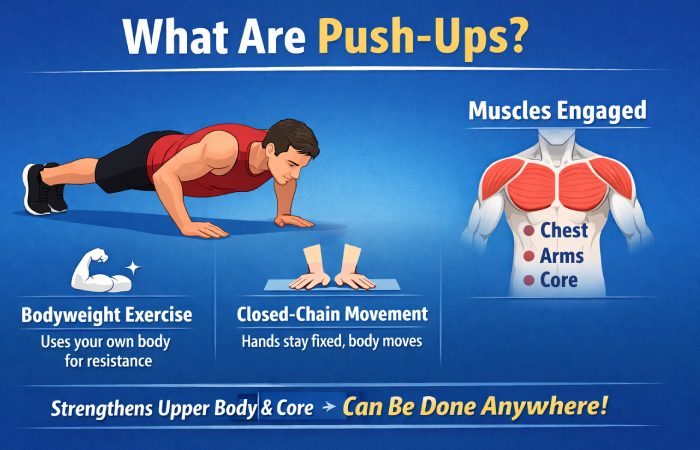
Push-ups are a compound bodyweight exercise that involves lowering and raising your body using your arms while maintaining a straight posture. They are classified as a closed-chain movement, meaning your hands remain fixed while your body moves.
Push-ups are widely used in strength training because they engage several muscle groups simultaneously, especially the upper body and core.
Muscles Worked in Push-Ups
Push-ups are not just a chest exercise—they are a full-body movement that activates multiple muscles.
Primary and Secondary Muscles
| Muscle Group | Specific Muscles | Role in Push-Ups |
|---|---|---|
| Chest | Pectoralis major & minor | Main pushing force |
| Arms | Triceps | Extend elbows during push |
| Shoulders | Anterior deltoids | Stabilize and assist pushing |
| Core | Rectus abdominis, obliques | Maintain body alignment |
| Back | Erector spinae, lats | Stabilize posture |
| Lower Body | Glutes, quads | Provide support and balance |
Push-ups mainly target the chest, shoulders, and triceps, while the core and lower body muscles help stabilize the movement.
Key Benefits of Push-Ups
Push-ups offer numerous physical and health benefits when performed regularly.
Major Benefits Overview
| Benefit | Description |
|---|---|
| Builds strength | Develops upper body and core muscles |
| Improves endurance | Enhances muscular stamina |
| No equipment needed | Can be done anywhere |
| Boosts heart health | Linked to reduced cardiovascular risk |
| Supports weight loss | Burns calories effectively |
| Improves posture | Strengthens stabilizing muscles |
Studies suggest that push-ups can improve muscle strength and may even reduce the risk of heart disease when performed regularly.
How to Do a Proper Push-Up
Correct form is essential to maximize results and prevent injury.
Step-by-Step Guide
| Step | Instructions |
|---|---|
| 1 | Start in a plank position |
| 2 | Place hands slightly wider than shoulders |
| 3 | Keep body straight from head to heels |
| 4 | Lower body until chest nearly touches floor |
| 5 | Push back up to starting position |
| 6 | Keep core engaged throughout |
Maintaining proper alignment ensures effective muscle activation and reduces injury risk.
Types of Push-Ups
Push-ups come in many variations to suit different fitness levels.
Beginner to Advanced Variations
| Level | Push-Up Type | Description |
|---|---|---|
| Beginner | Wall push-up | Performed against a wall |
| Beginner | Knee push-up | Reduced body weight resistance |
| Intermediate | Standard push-up | Traditional form |
| Intermediate | Incline push-up | Hands elevated |
| Advanced | Decline push-up | Feet elevated |
| Advanced | Diamond push-up | Targets triceps |
| Expert | One-arm push-up | High difficulty |
| Expert | Weighted push-up | Added resistance |
These variations allow progression as strength improves.
Push-Ups vs Other Exercises
Push-ups are often compared to other strength exercises like bench press or planks.
Comparison Table
| Exercise | Equipment Needed | Muscles Targeted | Difficulty | Benefits |
|---|---|---|---|---|
| Push-ups | None | Full upper body + core | Medium | Functional strength |
| Bench Press | Yes | Chest, triceps | Medium–High | Muscle mass gain |
| Plank | None | Core | Low–Medium | Stability |
| Dips | Yes | Triceps, chest | High | Upper body strength |
Push-ups stand out because they combine strength, stability, and convenience.
Common Mistakes to Avoid
Incorrect form can reduce effectiveness and increase injury risk.
Mistakes and Fixes
| Mistake | Problem | Solution |
|---|---|---|
| Sagging hips | Strains lower back | Engage core |
| Flaring elbows | Shoulder strain | Keep elbows at 30–45° |
| Fast reps | Poor muscle engagement | Slow down |
| Incomplete range | Reduced effectiveness | Full movement |
| Head dropping | Neck strain | Keep neutral spine |
Proper technique ensures maximum benefits and safety.
Push-Up Workout Plan
A structured plan helps you progress effectively.
Weekly Push-Up Routine
| Day | Workout |
|---|---|
| Monday | 3 sets of 10–15 push-ups |
| Tuesday | Rest or light cardio |
| Wednesday | 4 sets of incline push-ups |
| Thursday | Core training |
| Friday | 3 sets of decline push-ups |
| Saturday | Mixed variations |
| Sunday | Rest |
Consistency is key for noticeable improvements.
Push-Ups for Different Goals
Push-ups can be tailored based on fitness goals.
Goal-Based Training
| Goal | Recommended Variation | Reps |
|---|---|---|
| Strength | Decline/weighted push-ups | 6–10 |
| Endurance | Standard push-ups | 15–25 |
| Beginners | Knee/wall push-ups | 5–10 |
| Muscle growth | Slow tempo push-ups | 8–12 |
Adjust intensity depending on your fitness level.
Push-Ups for Beginners
If you’re new to exercise, start slow and build strength gradually.
Beginner Tips
| Tip | Explanation |
|---|---|
| Start with wall push-ups | Easier resistance |
| Focus on form | Prevent injuries |
| Increase reps gradually | Build endurance |
| Rest adequately | Allow muscle recovery |
| Stay consistent | Key to progress |
Advanced Push-Up Techniques
Advanced variations increase intensity and muscle engagement.
Advanced Training Methods
| Method | Description |
|---|---|
| Plyometric push-ups | Explosive movement |
| Archer push-ups | One-sided focus |
| One-arm push-ups | Maximum strength |
| Weighted push-ups | Add resistance |
| Tempo push-ups | Slow controlled reps |
These techniques are ideal for experienced individuals.
Health and Safety Considerations
Push-ups are generally safe but require proper care.
Safety Guidelines
| Concern | Recommendation |
|---|---|
| Wrist pain | Use push-up bars or fists |
| Shoulder issues | Modify form |
| Lower back pain | Engage core |
| Overtraining | Take rest days |
Always listen to your body and avoid pushing through pain.
Conclusion
Push ups are one of the most efficient and versatile exercises for building strength, improving endurance, and enhancing overall fitness. As a bodyweight exercise, they target multiple muscle groups—including the chest, arms, shoulders, and core—without requiring any equipment. One of their greatest advantages is their adaptability, allowing individuals of all fitness levels to modify the difficulty based on their strength and experience. Whether performed as part of a beginner routine or an advanced training program, push-ups contribute to improved muscular strength, better endurance, and even heart health. Incorporating push-ups into your daily routine can significantly boost your physical fitness and overall well-being, making them a timeless and powerful addition to any workout regimen.