

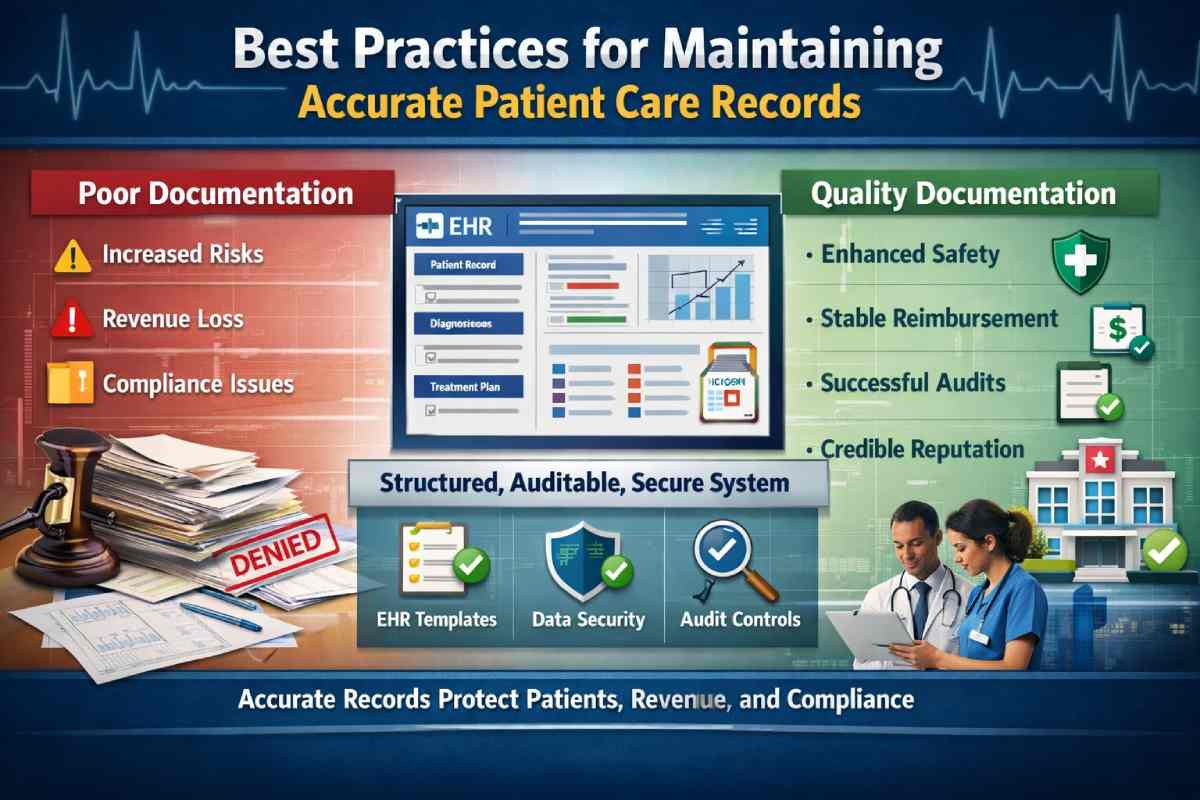
Accurate patient care records require a structured documentation system integrating EHR design, real-time discipline, coding precision, audit safeguards, and revenue alignment. Documentation is not paperwork—it is clinical risk infrastructure.
Most healthcare organizations do not fail because they “forget to document.” They fail because documentation is inconsistent, delayed, vague, poorly structured, or disconnected from compliance and reimbursement systems.
If you are searching for best practices for maintaining accurate patient care records, the direct answer is this:
Build a documentation system that standardizes structure, enforces timeliness, aligns coding, embeds verification, supports audits, and protects data security.
Anything less leaves clinical, legal, and financial gaps.
Why Accurate Patient Care Records Matter in 2026
Accurate documentation influences five core operational domains:
-
Patient safety
-
Malpractice defense
-
Regulatory compliance
-
Reimbursement integrity
-
Data interoperability and analytics
In the United States, documentation standards are shaped by:
-
Health Insurance Portability and Accountability Act
-
Centers for Medicare & Medicaid Services
-
The Joint Commission
These bodies do not evaluate “effort.” They evaluate evidence.
Regulatory Expectations at a Glance
| Regulator / Authority | What They Expect | Documentation Impact |
|---|---|---|
| HIPAA | Secure, accurate PHI handling | Access control & amendments |
| CMS | Medical necessity & coding accuracy | Reimbursement levels |
| Joint Commission | Timeliness & traceability | Accreditation status |
| OCR (HHS) | Breach prevention & response | Financial penalties |
Documentation errors can lead to:
-
Claim denials
-
Downcoding
-
Audit investigations
-
Civil penalties
-
Increased malpractice vulnerability
This is why documentation must be treated as infrastructure.
The 6-Pillar Documentation System Framework
Instead of listing scattered tips, high-performing organizations build documentation systems around six operational pillars.
| Pillar | Purpose | Common Failure Pattern | Control Mechanism |
|---|---|---|---|
| Structured EHR | Standardized data capture | Overuse of free text | Template governance |
| Real-Time Entry | Preserve clinical accuracy | End-of-day batch charting | Same-shift rule |
| Coding Alignment | Reimbursement protection | Unspecified diagnoses | Coding audits |
| Verification Loops | Prevent high-risk errors | Medication discrepancies | Dual review |
| Audit Controls | Compliance assurance | Reactive review only | Scheduled QA |
| Security Safeguards | PHI protection | Shared logins | Role-based access |
Each pillar reinforces the others. Remove one, and systemic risk increases.
Structured EHR Architecture: Design Determines Accuracy
Many organizations believe that adopting an EHR automatically improves documentation. It does not. Structure matters more than digitization.
Free Text vs Structured Documentation
| Dimension | Free Text Heavy | Structured Template |
|---|---|---|
| Coding linkage | Weak | Embedded |
| Audit defensibility | Low | High |
| Consistency | Variable | Standardized |
| Analytics readiness | Poor | Strong |
| Copy-paste risk | High | Controlled |
Illustrative Example:
A provider writes “HTN stable.”
A structured template requires stage, medication, and management plan. The latter supports compliance and billing accuracy.
Best practice includes:
-
Mandatory structured fields for diagnosis and medications.
-
Controlled narrative areas.
-
Quarterly template review to eliminate outdated prompts.
Real-Time Documentation Protocols
Delayed documentation introduces memory bias. Clinical nuance fades quickly.
Documentation Timing Risk Table
| Timing of Entry | Risk Level | Common Consequence |
|---|---|---|
| During encounter | Low | Accurate capture |
| Same shift | Moderate | Minor omissions |
| Next day | High | Detail loss |
| Several days later | Severe | Audit vulnerability |
The Same-Shift Rule
Document during or immediately after patient interaction whenever possible.
If late entries are unavoidable:
-
Clearly label as “Late Entry.”
-
Include date and time of actual event.
-
Never overwrite original documentation.
Transparent correction is defensible. Backdating is not.
Coding & Clinical Specificity: Where Revenue Is Won or Lost
Documentation and reimbursement are inseparable.
CMS guidelines emphasize medical decision-making complexity and specificity.
Specificity Comparison Example
| Vague Entry | Specific Entry | Operational Outcome |
|---|---|---|
| “Diabetes” | “Type 2 diabetes with neuropathy” | Higher coding precision |
| “Chest pain” | “Atypical chest pain, low cardiac risk” | Justified evaluation |
| “Follow-up” | “Follow-up in 2 weeks for medication titration” | Clear care plan |
Missing specificity often leads to:
-
Lower E/M levels.
-
Missed comorbidities.
-
Reduced DRG grouping.
Hospitals use Clinical Documentation Improvement (CDI) teams to proactively address these gaps.
Documentation clarity equals financial stability.
Verification Loops for High-Risk Documentation Zones
Some documentation errors carry disproportionate risk.
High-Risk Areas
| Risk Area | Potential Harm | Recommended Control |
|---|---|---|
| Medication reconciliation | Adverse drug event | Dual clinician review |
| Allergy documentation | Anaphylaxis | Mandatory confirmation field |
| Surgical laterality | Wrong-site procedure | Pre-op verification checklist |
| Discharge instructions | Readmission | Structured discharge template |
Verification loops create redundancy where harm probability is high.
This is operational risk management, not bureaucracy.
Internal Audit & Quality Assurance Systems
Audits convert documentation from reactive to proactive.
Audit Frequency Model
| Organization Size | Recommended Frequency |
|---|---|
| Solo practice | Quarterly chart sample |
| Multi-provider clinic | Monthly random review |
| Hospital network | Continuous automated monitoring + monthly QA |
Audits should evaluate:
-
Completeness.
-
Timeliness.
-
Coding alignment.
-
Signature authentication.
-
Copy-paste frequency patterns.
The National Committee for Quality Assurance (NCQA) and CMS quality programs frequently emphasize documentation integrity as part of performance measurement.
Security & Access Controls

Accurate records must also be secure.
Under HIPAA, organizations must implement reasonable administrative, physical, and technical safeguards.
Security Controls Checklist
| Control Type | Example Safeguard | Risk Mitigated |
|---|---|---|
| Technical | Two-factor authentication | Unauthorized access |
| Administrative | Access role policy | Overexposure of PHI |
| Physical | Secured server rooms | Data theft |
| Monitoring | Audit logs | Suspicious activity |
For EU providers, GDPR introduces stricter consent and data minimization standards.
Security is not separate from accuracy. Data integrity depends on access control.
AI & Automation in Clinical Documentation
AI scribes and ambient documentation tools are expanding rapidly.
Benefits vs Risks
| Benefit | Risk | Control Strategy |
|---|---|---|
| Faster note generation | Hallucinated content | Mandatory clinician review |
| Reduced burnout | Over-reliance | Random accuracy audits |
| Structured summaries | Context misinterpretation | Structured template integration |
Key principle:
The clinician remains legally responsible for every signed note.
Automation assists workflow. It does not transfer accountability.
Documentation Maturity Model
Organizations progress through stages of documentation capability.
| Level | Description | Risk Exposure | Typical Traits |
|---|---|---|---|
| Level 1 – Reactive | Paper or chaotic EHR | High | Inconsistent notes |
| Level 2 – Basic Digital | EHR without structure | Moderate | Template misuse |
| Level 3 – Structured & Audited | Standardized & monitored | Low | QA processes active |
| Level 4 – Optimized | AI-assisted + continuous improvement | Very Low | Real-time dashboards |
Most small practices operate at Level 2.
The greatest improvement typically occurs moving from Level 2 to Level 3.
Common Documentation Failures That Trigger Audits
| Failure Pattern | Why It Happens | Consequence | Prevention |
|---|---|---|---|
| Copy-paste cloning | Time pressure | Audit suspicion | Template redesign |
| Missing signatures | Workflow gaps | Legal vulnerability | EHR alerts |
| Generic assessment | Habitual shorthand | Downcoding | Specificity prompts |
| Delayed entries | Overbooked schedule | Memory error | Same-shift rule |
| Incomplete follow-up | Poor template design | Care gaps | Structured plan field |
These failures are systemic. Fix systems, not just behavior.
90-Day Implementation Roadmap
Documentation transformation should be phased.
Phase Plan Overview
| Phase | Focus | Key Actions |
|---|---|---|
| Phase 1 (Days 1–30) | Assessment | Conduct chart audit, identify top 3 gaps |
| Phase 2 (Days 31–60) | Standardization | Update templates, clarify policies |
| Phase 3 (Days 61–75) | Training | Targeted staff documentation training |
| Phase 4 (Days 76–90) | Monitoring | Launch audit schedule & KPI tracking |
Practical Example Scenario (Illustrative)
A 5-provider clinic identifies:
-
40% of notes missing specificity.
-
25% of medication lists outdated.
-
15% lacking follow-up detail.
After template standardization and audit loop implementation:
-
Coding accuracy improves.
-
Claim denials decline.
-
Audit preparedness strengthens.
Numbers will vary, but pattern remains consistent.
Who This Framework Is For (And Not For)
This framework is designed for:
-
US healthcare organizations.
-
Clinics seeking operational improvement.
-
Compliance-focused administrators.
-
Revenue cycle managers.
It is not a substitute for:
-
Legal counsel.
-
Certified coding consultation.
-
HIPAA compliance certification.
Use it as an operational improvement blueprint.
Final Verdict: Documentation Is Operational Survival
The best practices for maintaining accurate patient care records are not about writing longer notes or adding more paperwork. They are about designing a structured, auditable, and secure documentation ecosystem that supports clinical care, compliance, and financial stability. When documentation is treated as an administrative afterthought, risk compounds quietly, revenue begins to leak through denials and downcoding, and compliance exposure steadily grows. In contrast, when documentation is treated as clinical infrastructure, patient safety improves through clearer communication, reimbursement stabilizes through coding precision, audit resilience strengthens under regulatory scrutiny, and organizational credibility increases across stakeholders. In modern healthcare, accuracy is not a bonus standard of excellence—it is operational survival.