

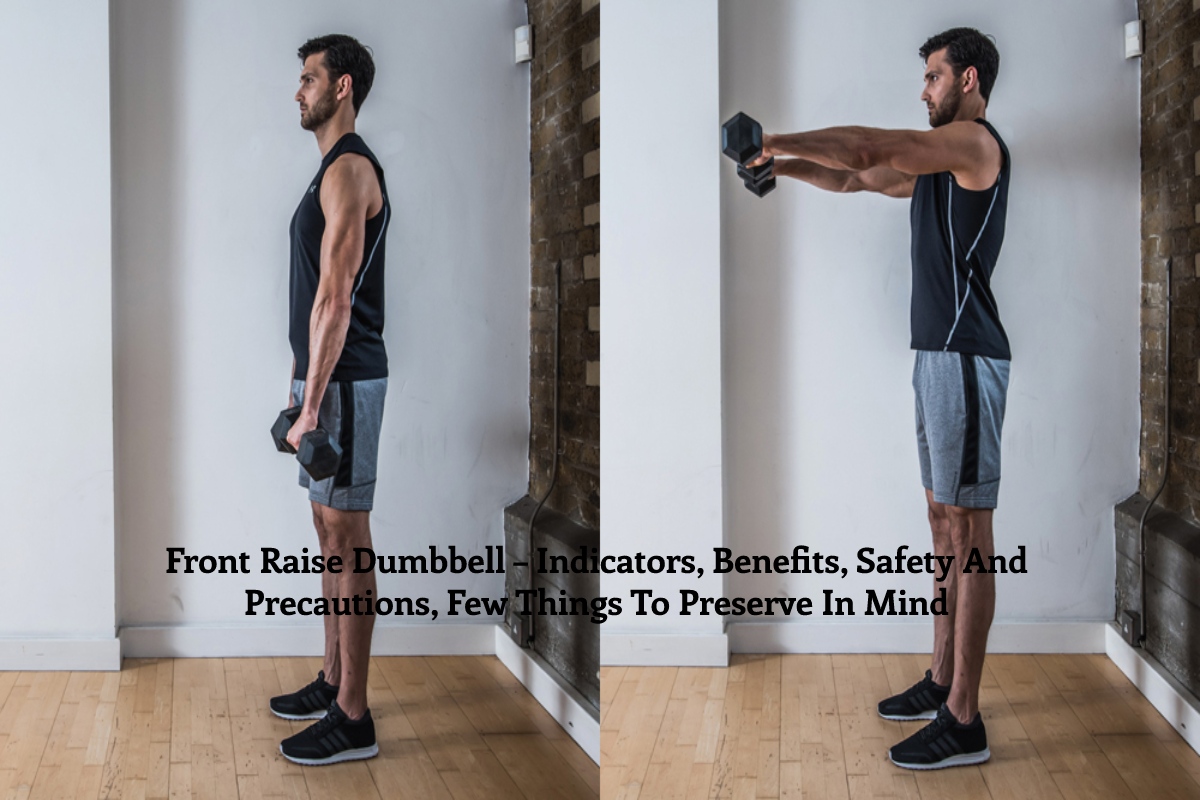
The dumbbell front raise is widely overused in modern workouts; while effective in isolation, it often becomes redundant when proper pressing exercises are already in place.
Most people search for the Dumbbell Front Raise to learn proper form and benefits. Here’s the direct answer:
Yes, it works—but for most lifters, it’s not necessary and often adds little value if you already train with pressing exercises..
What Is the Dumbbell Front Raise?
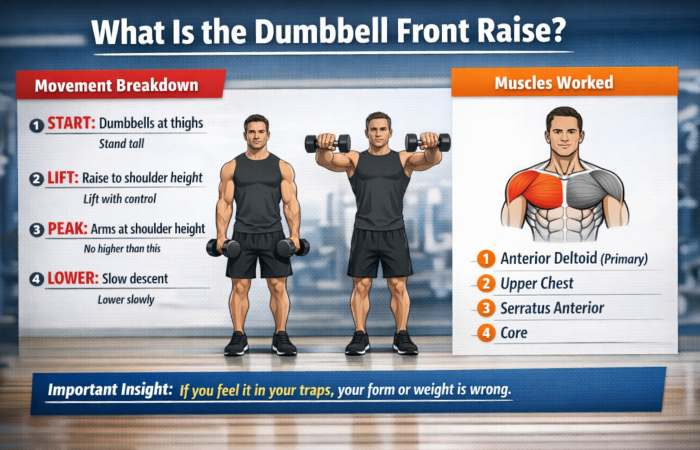
The Dumbbell Front Raise is an isolation exercise where you lift dumbbells in front of your body to target the anterior deltoid.
While it looks simple, the way you perform it—and whether you should perform it at all—makes a huge difference in your results.
Movement Breakdown
| Step | Action | Key Focus | Common Error |
| Start | Dumbbells at thighs | Neutral posture | Slouching |
| Lift | Raise arms forward | Controlled motion | Swinging |
| Peak | Shoulder height | Muscle tension | Lifting too high |
| Lower | Slow descent | Time under tension | Dropping weight |
Muscles Worked
Understanding muscle involvement helps explain why this exercise is often redundant.
| Muscle Group | Role | Activation Level |
| Anterior Deltoid | Primary mover | High |
| Upper Chest | Assists lift | Moderate |
| Serratus Anterior | Stabilization | Moderate |
| Core | Stability | Low–Moderate |
| Traps | Secondary (often overused) | Variable |
Important Insight:
If your traps dominate the movement, your form or weight selection is incorrect.
The Hidden Problem – Why Most People Don’t Need It
Most fitness guides stop at explaining how to do the exercise. They rarely address whether you actually need it.
Overlap With Pressing Exercises
If your routine includes:
- Bench Press
- Overhead Press
Then your front delts are already heavily activated.
Research from the American Council on Exercise and findings published in the Journal of Strength and Conditioning Research confirm that pressing movements significantly engage the anterior deltoid.
Volume Comparison
| Exercise Type | Front Delt Activation | Training Efficiency | Recommendation |
| Bench Press | High | High | Essential |
| Overhead Press | Very High | Very High | Essential |
| Front Raise | Moderate–High | Low (if redundant) | Situational |
Redundant Volume Explained
In training, more is not always better. There is a point where additional exercises stop contributing to growth and start adding fatigue.
| Type of Volume | Definition | Result |
| Effective Volume | Stimulates growth | Positive adaptation |
| Junk Volume | Adds fatigue only | No added benefit |
Front raises often become junk volume when:
- You already perform multiple pressing exercises
- Your total weekly shoulder volume is high
Imbalance Risk
Overemphasis on front delts leads to poor shoulder development.
| Muscle Group | Overtrained Effect | Undertrained Effect |
| Front Delts | Rounded shoulders | — |
| Side Delts | — | Narrow appearance |
| Rear Delts | — | Poor posture |
This is why exercises like:
- Lateral Raise
- Rear Delt Fly
are often more important.
When Front Raises Actually Make Sense
Despite the criticism, the exercise has valid use cases.
Use Case Breakdown
| Scenario | Why It Works | Recommendation |
| Weak Front Delts | Targets lagging muscle | Use moderately |
| Injury Rehab | Low-load control | Use light weights |
| Beginners | Builds coordination | Short-term use |
| Advanced Training | Isolation work | Optional |
Example Scenario
| Training Level | Weekly Shoulder Sets | Front Raise Role |
| Beginner | 8–10 sets | Skill building |
| Intermediate | 10–14 sets | Optional |
| Advanced | 14–18 sets | Fine-tuning |
How to Do Front Raise Dumbbell Correctly
Proper form determines whether the exercise is effective or harmful.
Step-by-Step Form
| Step | Instruction | Key Tip |
| 1 | Stand upright | Engage core |
| 2 | Hold dumbbells | Neutral grip |
| 3 | Slight elbow bend | Protect joints |
| 4 | Lift to shoulder height | Avoid overextension |
| 5 | Lower slowly | Control movement |
Tempo Guide
| Phase | Duration | Purpose |
| Lift | 1–2 sec | Controlled effort |
| Hold | 0–1 sec | Peak tension |
| Lower | 2–3 sec | Muscle engagement |
Quick Form Checklist
- No swinging
- No leaning back
- Controlled movement
- Moderate weight
Common Mistakes
Mistakes reduce effectiveness and increase injury risk.
Mistake Analysis
| Mistake | Cause | Effect | Fix |
| Too heavy weight | Ego lifting | Momentum replaces tension | Reduce load |
| Swinging body | Poor control | Lower back strain | Tighten core |
| Lifting too high | Misunderstanding | Joint stress | Stop at shoulder level |
| Overtraining | Excess volume | Imbalance | Reduce frequency |
Better Alternatives for Most People
If your goal is efficient shoulder development, other exercises deliver better results.
Exercise Comparison
| Exercise | Primary Benefit | Efficiency | Best For |
| Front Raise | Isolation | Low | Specific targeting |
| Lateral Raise | Width | High | Aesthetics |
| Rear Delt Fly | Balance | High | Posture |
| Overhead Press | Strength | Very High | Overall development |
Why Alternatives Win
- Train neglected muscles
- Improve symmetry
- Deliver better return on time invested
How to Program Front Raises Smartly
Programming determines whether the exercise helps or hinders progress.
Programming
| Level | Sets | Reps | Frequency |
| Beginner | 2–3 | 10–15 | 1–2x/week |
| Intermediate | 2–4 | 8–12 | Optional |
| Advanced | 2–3 | 12–15 | Rare use |
Weekly Volume Example
| Exercise | Sets | Contribution |
| Overhead Press | 4 | Major |
| Bench Press | 4 | Major |
| Lateral Raise | 3 | Essential |
| Front Raise | 2 | Optional |
Front Raise Variations Ranked
Different variations change effectiveness and safety.
Variation Comparison
| Variation | Control | Effectiveness | Risk Level |
| Single-arm | High | High | Low |
| Alternating | High | High | Low |
| Plate | Medium | Medium | Low |
| Band | Medium | Medium | Very Low |
| Barbell | Low | Low | Higher |
Decision Framework – Should You Do Front Raises?
Use this quick decision system:
Decision Table
| Question | Yes | No |
| Do you bench/press regularly? | Skip | Consider |
| Do you have weak front delts? | Include | Skip |
| Do you feel shoulder pain? | Avoid | Proceed carefully |
Final Verdict
The Dumbbell Front Raise is not a bad exercise—it’s simply overused. For most people, it adds little real value because the anterior delts are already heavily trained through pressing movements. Instead of improving results, it often increases unnecessary fatigue and can even take focus away from more effective exercises that build balanced, stronger shoulders. The key is not to eliminate it completely, but to use it with clear purpose rather than including it by default.