

Australia and the UK are among the most popular destinations for healthcare professionals seeking international careers. Doctors, nurses, pharmacists, physiotherapists, dentists and other allied health professionals have traditionally considered UK registration or Australian assessment as primary routes to work abroad.
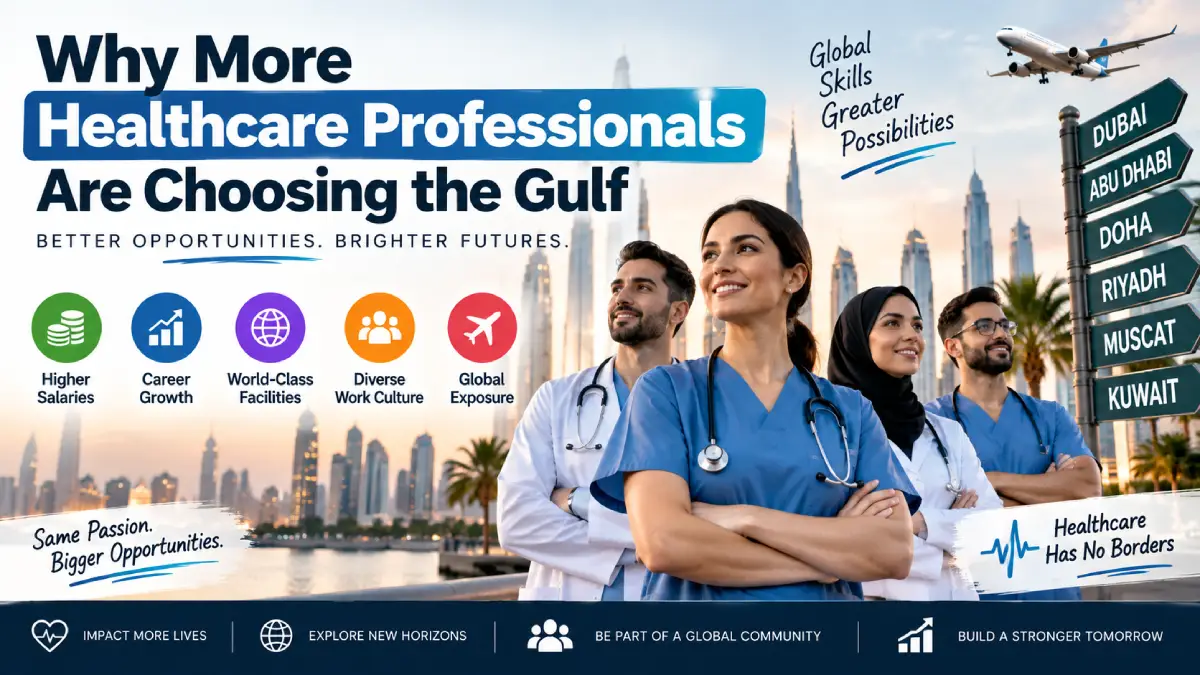
Healthcare jobs in Gulf countries are getting more attention from internationally trained professionals who want competitive salaries and a potentially more direct route to overseas employment. Anyone considering this option should understand that professional licensing is an important first step.
Candidates may need to pass a licensing examination or meet specific assessment requirements as per country and profession. Those preparing for this journey can browse Academically Global’s Gulf licensing exam courses to understand key pathways and prepare for their international career plans.
The UAE, Saudi Arabia, Qatar, Kuwait, Bahrain and Oman have developed large healthcare sectors and continue to attract qualified professionals across different specialties. This has made the Gulf an increasingly competitive alternative to Australia and the UK for international healthcare careers
The Gulf can offer a faster route to an international healthcare job
One of the biggest attractions of the Gulf is the relatively direct connection between professional licensing and employment.
Healthcare professionals generally need to obtain a license from the concerned authority before practicing such as the Dubai Health Authority (DHA), Department of Health (DOH) in Abu Dhabi, or other UAE regulators.
Similarly for Saudi Arabia, Qatar, Oman, Bahrain and Kuwait have their own professional licensing systems.
The important difference is that these are designed to establish eligibility to work in that healthcare market.
Professionals who are considering Australia or the UK may have to navigate professional registration, qualification assessment, English-language requirements, immigration requirements and, depending on the profession, examinations or additional assessment stages.
Australia is certainly continuing to prioritize skilled workers in healthcare. From July 2026, healthcare occupations enjoy high processing priority under Australia’s immigration framework.
However, a strong immigration pathway does not necessarily mean the fastest route to a first international job.
Who want overseas work experience before making a permanent migration decision, the Gulf can therefore be an attractive alternative.
Tax-free salaries can significantly change your take-home income
Salary is only one part of an international job offer.
Take-home pay is often more important.
This is where the Gulf has a major advantage for non -native healthcare professionals. The UAE does not levy personal income tax on individuals. This means that employment income is generally not reduced by UAE personal income tax.
Across the Gulf, employment packages can also include benefits such as:
- Housing allowance or accommodation
- Health insurance
- Annual air tickets
- Paid annual leave
- Transport allowances
- Family-related benefits in some contracts
- End-of-service benefits
As a result, comparing only the advertised salary between countries can be misleading.
If we take the example of a professional earning a higher gross salary in Australia or the UK may still have a significant portion deducted through income tax and other contributions. In the UK, the 2026–27 income-tax rates range from 20% to 45%, depending on taxable income and circumstances.
This is why the concept of a tax-free healthcare salary Gulf professionals can earn has become an important part of the international career conversation.
The Gulf is not completely tax-free in every sense- VAT and other taxes can apply to spending and businesses, but personal employment income is treated differently from countries such as the UK.
Healthcare professionals can benefit from established international demand
The Gulf has invested heavily in hospitals, specialist centers, private healthcare groups and medical infrastructure. This has created opportunities for professionals across several disciplines, including:
Doctors: General practitioners, specialists and consultants
Nurses: Registered nurses, specialist nurses and senior nursing professionals
Pharmacists: Hospital, community and clinical pharmacy professionals
Allied health: Physiotherapists, occupational therapists, radiographers, medical laboratory professionals and others
Dentists: General dentists and specialists
The exact opportunities depend on the country, specialty, qualification, experience and licensing category.
This is particularly important for professionals who may not yet have the profile required for some highly competitive international pathways.
The Gulf can provide an opportunity to gain experience in a multinational healthcare environment, strengthen a CV and use that experience when considering another country later.
Licensing exams are often the key to unlocking Gulf opportunities
The Gulf is not an “easy route” where professionals can simply arrive and start working. Professional licensing is essential, and the requirements vary depending on the country, profession and regulatory authority.
Professionals should understand which licensing authority applies to their profession, whether an examination is required, what documents need to be verified and what eligibility criteria they must meet.
Preparing for the right examination can save time and help candidates approach the licensing process with greater confidence. The goal should not simply be to pass an exam. Candidates should understand the complete pathway from eligibility and document verification to examination and professional licensing.
The Gulf offers an attractive middle ground between career and migration
Australia and the UK are often considered with permanent migration in mind.
Australia has various skilled visa streams, including employer sponsored and points tested options. Its skilled workers framework offers numerous healthcare professions. This makes Australia a particularly feasible option for professionals who want to build a long-term life abroad.
The UK also offers an established healthcare system and internationally recognized professional experience.
Not every healthcare professional is ready to make a permanent migration decision.
Some want to:
- Work abroad for a few years
- Save money
- Gain international exposure
- Support their family financially
- Experience a different healthcare system
- Build a stronger professional profile
- Decide later whether they want permanent migration
For these professionals, the Gulf can serve as a career destination rather than an immediate settlement destination.
That distinction is important.
The overall employment package can be more important than basic salary
A common mistake when comparing countries is looking at salary alone.
An international healthcare offer should be evaluated as a total compensation package.
Consider these factors:
The Gulf countries can be an attractive option for healthcare professionals, especially for those looking for better take-home pay. In the UAE, there is generally no personal income tax, although tax rules differ across other Gulf countries. Licensing requirements also vary by country, and some employers may offer benefits such as housing as part of the employment package.
Australia and the UK have established registration processes for healthcare professionals and both apply income tax. While all three regions offer valuable international work experience, Australia and the UK may be more suitable for professionals looking at long-term migration. Family benefits and other perks, including accommodation, usually depend on the employer and the terms of the contract.
The Gulf may offer a strategic stepping stone
Choosing the Gulf does not necessarily mean giving up on Australia or the UK.
For some professionals, it can be a strategic first step.
A newly experienced physiotherapist, pharmacist or nurse may want international exposure without committing to a lengthy migration process. The Gulf can offer an opportunity to gain overseas experience, strengthen professional skills and later reassess options in Australia or the UK. However, Gulf experience does not automatically guarantee registration or migration eligibility, as each country has its own regulatory and immigration requirements.
So, is the Gulf better than Australia or the UK?
There is no universal winner.
The right destination depends on what you want from your international healthcare career.
Choose the Gulf if you prioritize:
- Faster access to overseas employment
- Competitive take-home earnings
- Potential tax advantages
- Employer-provided benefits such as accommodation
- International healthcare experience
Consider Australia if you prioritize:
- Long-term migration and permanent residency pathways
- Strong demand across the healthcare sector
- Long-term career development
- Internationally recognized healthcare experience
- A structured professional registration pathway
Consider the UK if you prioritize:
- Working within the NHS
- Building a long-term career in the UK healthcare system
- Internationally recognised healthcare experience
- A structured registration pathway
- Potential routes to long-term settlement
Healthcare professionals have more choices
Healthcare professionals now have more international career options than ever before.
The traditional thinking was simple:
Study → qualify → choose Australia or the UK → migrate.
Today, the decision is more strategic:
Where is my profession in demand? What licensing pathway can I realistically complete? What will my take-home income be? What benefits will I receive? Do I want temporary international experience or permanent migration?
Choose the pathway that fits your qualification, experience, financial goals and long-term career plan.