

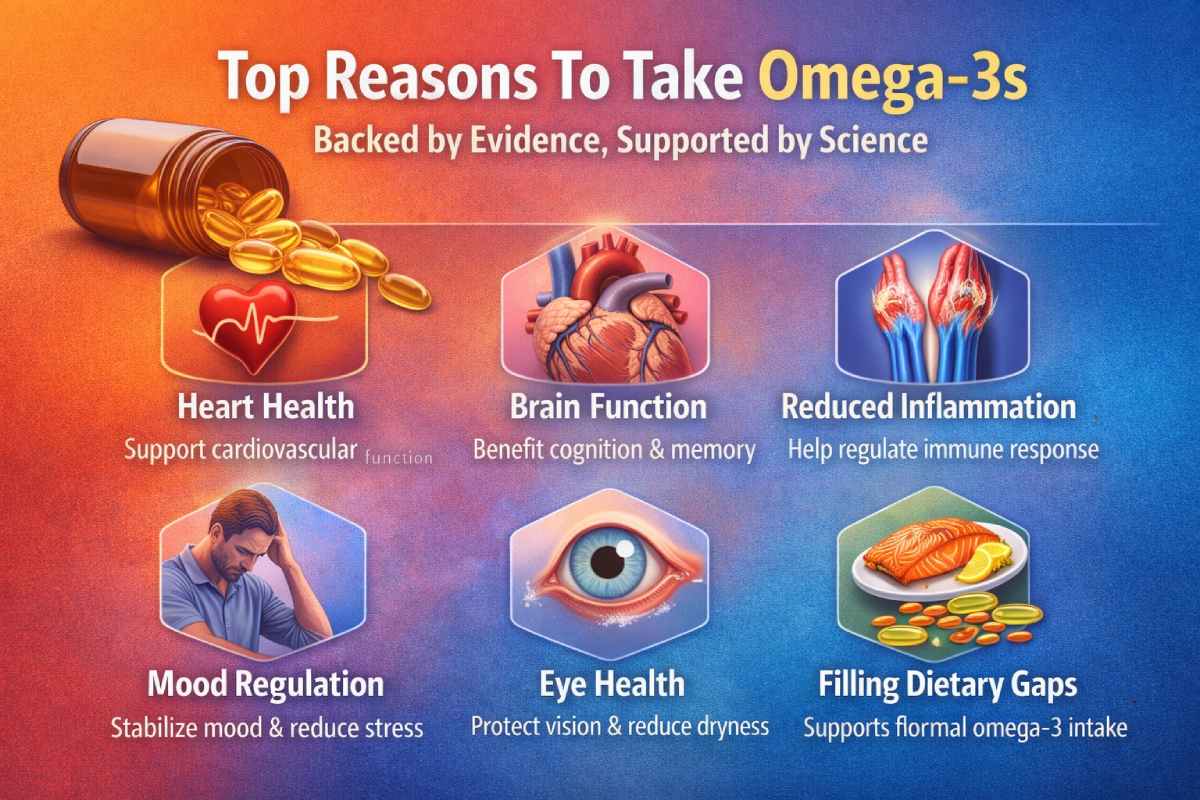
Omega-3 fatty acids are not quick-fix supplements but foundational nutrients that restore balance in inflammation, cellular health, and long-term disease risk created by modern diets.
Here is the direct answer: most people benefit from adequate omega-3 intake because modern diets are disproportionately high in omega-6 fats and low in EPA and DHA. That imbalance influences inflammation, cardiovascular risk, brain function, and metabolic health. Increasing omega-3 intake—through fatty fish or well-formulated supplements—helps correct that imbalance and supports long-term health.
Modern food systems have quietly changed our fat intake. Industrial seed oils, ultra-processed foods, and grain-fed animal products have increased omega-6 consumption. At the same time, fatty fish consumption has declined in many populations.
The result is not a dramatic deficiency you can feel overnight. It is a slow shift in how your body regulates inflammation, blood clotting, vascular tone, and neural signaling.
Omega-3 fatty acids—particularly EPA and DHA—help restore structural and inflammatory balance. They are not stimulants. They do not “boost” you. They integrate into cell membranes and change how your cells behave.
That is why organizations such as the American Heart Association and the National Institutes of Health recognize their role in cardiovascular and overall health.
What Omega-3s Actually Are And Why Types Matter
Not all omega-3s are interchangeable. This is where many simplified guides fall short.
ALA vs EPA vs DHA
| Type | Found In | What It Mainly Does | Practical Reality |
| ALA | Flax, chia, walnuts | Energy + precursor | Converts poorly to EPA/DHA |
| EPA | Fatty fish, algae | Inflammation regulation | Directly usable |
| DHA | Fatty fish, algae | Brain & retina structure | Essential for neural integrity |
Your body can convert ALA into EPA and DHA, but conversion rates are often low. For someone relying entirely on plant sources, DHA levels may remain suboptimal.
This matters because DHA is a structural fat in the brain and retina. EPA plays a strong role in inflammation resolution and cardiovascular function.
POV reminder: Omega-3s are structural regulators. If the structure is wrong, signaling is wrong.
Reason #1 — Cardiovascular Protection Beyond Cholesterol
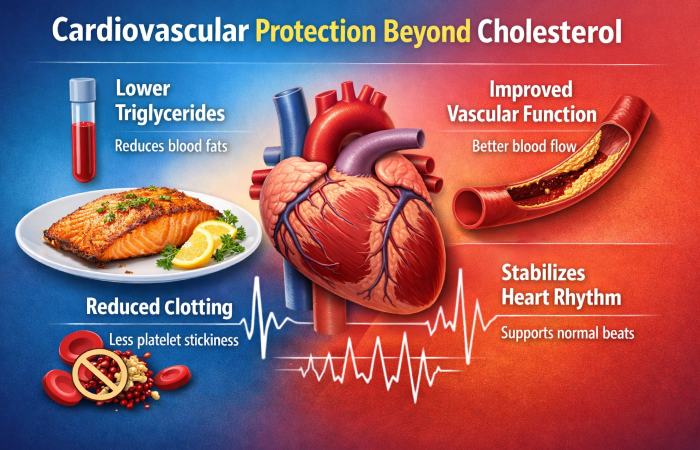
When people hear “omega-3,” they think heart health. That association is justified—but often oversimplified.
Omega-3s affect multiple cardiovascular mechanisms:
| Risk Factor | Omega-3 Influence |
| High triglycerides | Clear reduction |
| Blood vessel stiffness | Improved elasticity |
| Abnormal clotting | Reduced platelet aggregation |
| Irregular heart rhythm | Potential stabilization |
Unlike cholesterol-lowering drugs that target one marker, omega-3s improve the environment in which the cardiovascular system operates.
The American Heart Association has long recommended fatty fish consumption for heart health. Prescription-strength EPA formulations are even used clinically for severe hypertriglyceridemia.
Important nuance: Omega-3s are not a replacement for statins, blood pressure medication, or lifestyle change. They are foundational support.
Reason #2 — Brain Function and Cognitive Aging
DHA is a major structural component of the brain. It influences:
- Synaptic plasticity
- Neuronal membrane fluidity
- Signal transmission efficiency
| Brain Domain | How Omega-3s Help |
| Memory | Supports neuronal resilience |
| Processing speed | Improves membrane dynamics |
| Aging brain | May slow structural decline |
From pregnancy to old age, DHA demand persists.
The World Health Organization emphasizes DHA importance during pregnancy because fetal brain development depends heavily on it.
Example scenario:
Two adults eat similar diets except one consumes fatty fish twice weekly. Over years, their DHA levels differ. That difference influences neuronal membrane composition—a subtle change that may matter more at age 65 than at 35.
Reason #3 — Inflammation Control The Real Core Benefit
Inflammation is not the enemy. Unresolved inflammation is.
Omega-3s contribute to the production of specialized pro-resolving mediators—molecules that help “turn off” inflammatory responses once a threat is handled.
| Condition Category | Role of Chronic Inflammation | Omega-3 Impact |
| Cardiovascular | Arterial damage | Reduced inflammatory signaling |
| Metabolic | Insulin resistance | Improved cellular response |
| Autoimmune | Immune overactivation | Modulation |
| Musculoskeletal | Tissue breakdown | Reduced inflammatory mediators |
This is the structural argument: omega-3s don’t suppress immunity—they rebalance resolution pathways.
Reason #4 — Mental Health and Emotional Stability
Emerging research connects omega-3 status to mood regulation, especially EPA.
The National Institutes of Health notes that omega-3 supplementation has shown benefit in certain depressive disorders, particularly as an adjunct to treatment.
| Mental Health Area | Proposed Mechanism |
| Depression | Reduced neuroinflammation |
| Anxiety | Neurotransmitter modulation |
| Stress | HPA-axis regulation |
This article is not suggesting omega-3s replace therapy or medication. It suggests that biological terrain matters.
Reason #5 — Eye and Vision Health
DHA is heavily concentrated in retinal photoreceptors.
Low intake may contribute to:
- Dry eye symptoms
- Visual fatigue
- Age-related retinal vulnerability
In a screen-dominated era, this structural support becomes increasingly relevant.
Reason #6 — Joint Health and Mobility
Omega-3s influence inflammatory mediators involved in joint stiffness and pain.
| Joint Concern | Potential Effect |
| Rheumatoid arthritis | Reduced stiffness |
| Exercise soreness | Faster recovery |
| Age-related wear | Improved mobility support |
They are not cartilage rebuilders. They reduce inflammatory load.
Reason #7 — Metabolic and Liver Health
Omega-3s can support:
- Triglyceride metabolism
- Insulin signaling
- Liver fat regulation
| Metabolic Factor | Influence |
| Insulin sensitivity | Improved in some populations |
| Fatty liver markers | Reduction observed |
| Lipid balance | Better triglyceride profile |
Again, structural support—not a fat-loss shortcut.
Who This Is For And Who It’s Not For
Most relevant for:
- People who eat fish less than twice weekly
- Adults with cardiovascular risk factors
- Pregnant individuals (DHA is critical)
- Aging adults concerned about cognition
- People with high-inflammatory lifestyles
Less relevant for:
- Individuals already consuming fatty fish 3–4 times weekly
- Those expecting rapid “feel it tomorrow” results
Food vs Supplements: Practical Decision Framework
| Option | Pros | Trade-Offs |
| Fatty fish (salmon, sardines, mackerel) | Whole-food nutrients | Cost, access |
| Algae oil | Vegan EPA/DHA | Higher price |
| Fish oil capsules | Convenient | Quality varies |
| Cod liver oil | Added vitamins A & D | Risk of excess vitamin A |
Decision rule:
- If you eat fatty fish 2–3 times weekly, supplementation may be unnecessary.
- If you rarely eat fish, a moderate-dose EPA/DHA supplement is practical.
In the US, supplements are regulated as foods under the FDA. In the EU, EFSA sets upper intake guidance. Quality varies globally—third-party testing matters.
How Much Omega-3 Do You Need?
Guidelines commonly referenced by bodies like the National Institutes of Health:
| Goal | Typical Daily EPA+DHA |
| General wellness | 250–500 mg |
| Heart support | Around 1,000 mg |
| High triglycerides | 2,000–4,000 mg (medical supervision) |
| Pregnancy | ~300 mg DHA |
More is not always better. Extremely high doses can increase bleeding risk, especially alongside anticoagulants.
Risks, Myths, and Limitations
| Concern | Reality |
| “Fish oil causes bleeding” | Mainly at very high doses |
| “Plant omega-3 is enough” | Conversion often insufficient |
| “More capsules = better health” | Diminishing returns |
| Contaminants | Reputable brands purify oils |
Always consult a healthcare professional if you:
- Take blood thinners
- Have bleeding disorders
- Are preparing for surgery
The Bigger Picture: Maintenance, Not Magic
Omega-3s are not miracle pills. They do not override poor diet, smoking, inactivity, or unmanaged stress.
They function as biological maintenance.
In a dietary environment that has drifted from ancestral fatty acid balance, restoring EPA and DHA intake is less about optimization and more about correction.
The real benefit compounds slowly. You may not feel a dramatic shift. But over years, membrane composition, inflammatory balance, and vascular integrity improve in quiet but meaningful ways.
If you are deciding whether omega-3s are worth taking, the honest answer is this:
For most people eating modern diets, yes—adequate omega-3 intake is one of the most evidence-supported, structurally meaningful nutritional interventions available. Consistency matters more than megadoses. Quality matters more than branding. And balance matters more than hype.