

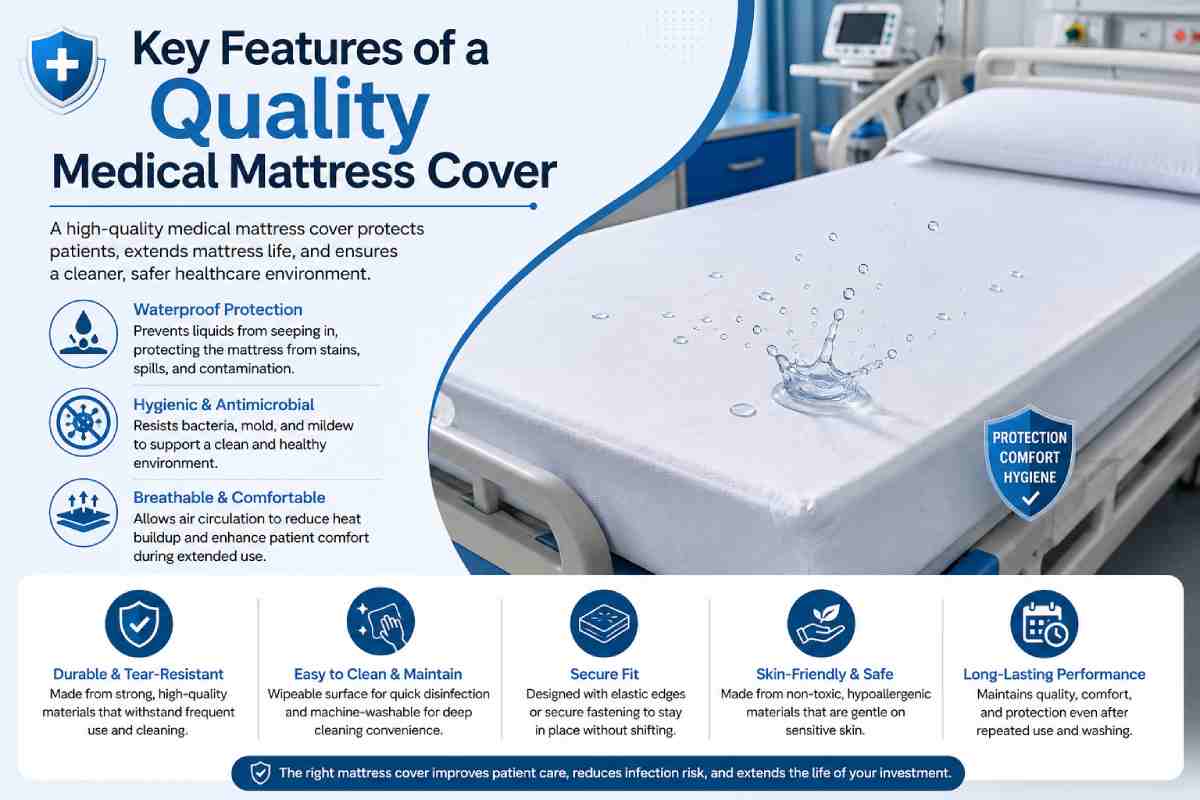
A hospital mattress can go through far more wear than a typical mattress at home. It may be used continuously, cleaned frequently and exposed to moisture, bodily fluids and regular patient movement.
The mattress cover is the first layer protecting it.
A good medical mattress cover needs to do more than simply fit over the mattress. It should provide an appropriate barrier, withstand the facility’s cleaning procedures and remain intact through repeated use. Comfort matters too, particularly when patients may spend extended periods in bed.
For hospitals, care homes and other healthcare facilities comparing mattress covers, these are some of the features worth looking at.
1. Effective Fluid Protection
Fluid protection is one of the first things to consider.
Hospital beds may be exposed to perspiration, urine, wound drainage, spilled drinks and other liquids. If moisture reaches the internal mattress materials, it can be difficult to clean effectively and may shorten the usable life of the mattress.
A quality medical mattress cover should provide a suitable barrier between these liquids and the mattress core.
Check whether the cover is described as waterproof or water-resistant. The terms are not interchangeable.
Water-resistant materials can resist limited moisture but may eventually allow liquid to pass through. Waterproof materials are designed to provide a stronger barrier against liquid penetration when used within their specified conditions.
For environments with regular fluid exposure, this difference can be important.
2. Easy-to-Clean Surface
Hospital mattresses need to be cleaned regularly, particularly when beds are used by different patients.
The cover should therefore have a surface that can be cleaned without unnecessarily complicated procedures.
Smooth surfaces can make it easier to wipe away contamination because there are fewer areas where moisture or debris can collect.
However, facilities should always check the manufacturer’s cleaning instructions.
A cover may be compatible with some cleaning products but not others. Using an unsuitable chemical or concentration can gradually damage the surface, even if there is no obvious problem after the first few cleaning cycles.
Before purchasing covers in bulk, make sure their care requirements match the cleaning procedures already used within the facility.
3. Strong Seams and Construction
The main surface is only one part of a mattress cover.
Seams, corners, zippers and other joins can become weak points if they are poorly designed or damaged.
This is particularly important for waterproof covers. A waterproof fabric provides limited protection if fluid can pass through a seam or damaged closure.
Look closely at how the cover is constructed.
Seams should remain secure under normal movement and cleaning. Corners should fit properly without placing excessive tension on the material.
If the cover uses a zipper, check how the zipper area is protected and whether the closure remains secure when the mattress is in use.
These small details can make a significant difference over the product’s service life.
4. Durable Materials
Medical mattress covers are expected to cope with frequent use.
Patients move and reposition themselves on the bed. Healthcare staff may adjust the mattress or transfer patients. The surface is cleaned repeatedly and may come into contact with medical equipment.
Over time, this can place considerable stress on the cover.
A good cover should resist common forms of damage such as tearing, cracking and peeling under its intended conditions of use.
When evaluating a hospital bed mattress cover, look beyond how the product feels when it is new. Consider the material, construction and cleaning requirements, and ask what information the supplier can provide about durability and expected use.
For healthcare facilities purchasing covers at scale, longer-lasting products can also help reduce the frequency of replacement.
5. Proper Fit
Fit is easy to overlook, but it affects both protection and everyday use.
A cover that is too loose can wrinkle or move as the patient changes position. Excess material may also make it harder to keep the sleeping surface smooth.
A cover that is too tight creates a different problem. Excessive tension can place stress on seams, corners and zippers.
The cover should match the dimensions and depth of the mattress it is intended to protect.
This becomes particularly important when a facility uses several types of hospital mattresses. A single cover size may not be suitable for every bed.
Before placing a large order, confirm mattress dimensions and check the manufacturer’s sizing specifications.
6. Compatibility with the Mattress
Not all hospital mattresses work in the same way.
Some are simple foam mattresses, while others use more complex pressure redistribution systems or specialised surfaces.
The mattress cover should not interfere with the intended function of the mattress.
A cover that is excessively stiff or poorly fitted, for example, could change how the sleeping surface feels or responds under the user’s weight.
For specialised medical mattresses, check the mattress manufacturer’s recommendations before introducing a different cover.
Compatibility should be considered part of product selection rather than something checked after installation.
7. Patient Comfort
A hospital mattress cover is a protective product, but patients remain in direct contact with the sleeping surface for long periods.
Comfort therefore deserves attention.
Some protective materials can feel stiff, warm or noisy when the person moves. The extent of this varies according to the material and construction.
A quality cover should provide the required protection without unnecessarily compromising the comfort of the mattress.
Temperature is worth considering as well. If a cover traps excessive heat or moisture around the sleeping surface, it may become uncomfortable during longer periods of use.
The right balance will depend on the type of mattress and the healthcare environment.
8. Resistance to Repeated Cleaning
Cleaning does not only remove contamination. Over time, it can also place stress on the cover itself.
Repeated exposure to cleaning agents can affect certain materials. Surfaces may become brittle, discoloured or begin to crack.
Once the protective surface is damaged, the cover may no longer provide the same level of fluid protection.
This is why compatibility with cleaning procedures matters so much.
Facilities should follow the manufacturer’s recommended products, concentrations and contact times where applicable. Staff should also avoid assuming that stronger cleaning chemicals automatically provide a better result.
If a facility changes its cleaning products, it may be worth checking that the new products remain compatible with its mattress covers.
9. Easy Inspection
Damage is not always immediately obvious.
A small crack near a seam or a puncture on the side of the mattress may be missed during routine bed preparation.
Medical mattress covers should be inspected regularly, so designs that make this process straightforward can be helpful.
Staff should be able to check the main surface, sides, corners and closures for signs of wear.
Look for peeling, cracking, tears, damaged seams and problems with zippers or other closures.
If the cover is removable, the mattress underneath should also be inspected according to the healthcare facility’s procedures.
Regular checks can identify damage before it develops into a larger problem.
10. Suitable for the Healthcare Environment
A mattress cover that works well in one healthcare setting may not necessarily be the best option in another.
A general hospital ward, long-term care facility and specialist clinical environment can have different requirements.
Consider who will use the mattress, how frequently beds turn over, what types of fluid exposure are likely and how the cover will be cleaned.
The expected lifespan matters as well.
A cheaper cover that needs frequent replacement may not offer better long-term value than a more durable product. Purchase price should therefore be considered alongside maintenance and replacement frequency.
What Should You Look for Before Buying?
When comparing medical mattress covers, start with the requirements of the bed and healthcare environment.
Check the level of fluid protection and whether the cover can withstand the facility’s normal cleaning process. Look at the seams, closures and overall construction rather than focusing only on the main fabric.
Fit should also be confirmed carefully, particularly when purchasing covers for different mattress models.
Finally, ask what happens after months of regular use.
Can the cover tolerate repeated cleaning? Is damage easy to identify? Can the cover be replaced independently without replacing the mattress?
These practical questions often reveal more about product quality than appearance alone.
Choosing a Medical Mattress Cover for Long-Term Use
A hospital bed mattress cover may appear to be a relatively simple product, but its performance can affect mattress maintenance, cleaning and longevity.
The best choice is one that provides appropriate fluid protection, fits correctly and can cope with the realities of a healthcare environment.
Durability matters because the cover will be cleaned and used repeatedly. Construction matters because seams and closures can become weak points. Comfort matters because the cover remains part of the patient’s sleeping surface.
Rather than selecting a product based on one feature, look at how the complete cover performs.
A quality medical mattress cover should protect the mattress consistently without creating unnecessary work for healthcare staff. If it can continue doing that after repeated use and cleaning, it is doing exactly what it was designed to do.