

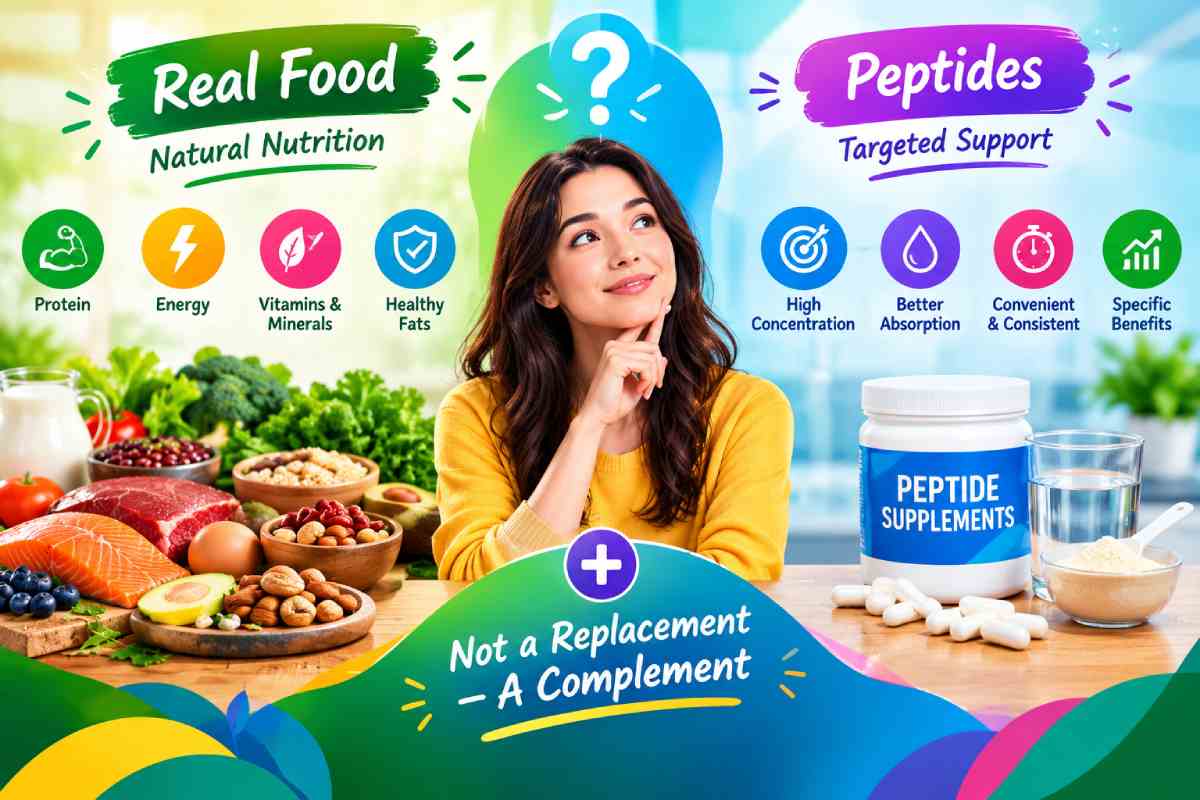
We already know where protein comes from. Walk into a supermarket and you can find it almost everywhere; meat, fish, eggs, dairy, beans, nuts and plenty more. So why complicate things? It is a fair question. And honestly, peptides are not about pretending that ordinary food suddenly stopped working. The more interesting question is whether every nutritional need can realistically be handled through the same food sources, in the same form, every day.
1. Food Works. But Real Life Gets in the Way.
For most people, food should remain the starting point. A proper meal doesn’t just bring protein to the table; it comes with energy, vitamins, minerals, fats, carbohydrates and other nutrients. There is a reason nutrition professionals don’t treat food as something to be replaced casually.
But knowing what works nutritionally and being able to make it work consistently are two different things.
Building every requirement around whole foods can become complicated. That is because someone may have a busy schedule, limited appetite, particular dietary requirements, or simply need a more controlled nutritional ingredient for a specific application.
That doesn’t make food inadequate. It simply means one format cannot solve every nutritional scenario. That is the gap worth paying attention to. Food isn’t the problem. The limitation is that food isn’t always the most convenient or specialized delivery format especially where one needs solutions that bypass the digestive bottlenecks of raw protein.
For those seeking highly concentrated bio-active compounds without the filler, identifying a reliable peptide source canada brand becomes essential for maximum efficiency, targeted tissue recovery, and clinical-grade standardization that a standard daily diet alone cannot duplicate.
2. Sometimes You Need a Protein Solution That is More Than a Meal
Think about the difference between eating for general nourishment and developing something for a specific nutritional purpose. They aren’t really the same job. A meal is broad by nature. It brings several things together. A peptide-based ingredient can be much more focused.
That can be useful when:
- You need a concentrated protein ingredient
- Keeping portions practical matters
- Consistency from one serving to another is important
- You’re developing a product with a defined nutritional profile
- Or convenience has to fit around a demanding routine.
For a product developer, this changes the conversation completely. The question isn’t simply, “How much protein can we put in this?”
It becomes: “What form of protein makes the most sense for what we’re trying to create?”
That is a formulation question—and good formulation is rarely about choosing the obvious ingredient and stopping there.
3. Digestion and Bioavailability Factor
When you eat whole protein from food, your stomach and enzymes have to work hard to break down those complex 3D folds. This takes hours, and the protein is entirely taken apart into individual amino acids before absorption.
On the other hand, because peptide supplements are “pre-digested” during manufacturing, they skip a major step of gastrointestinal breakdown. They dissolve easily in liquids and are absorbed rapidly through specialized pathways (like the PepT1 transporter in your gut) that can take in small di- and tri-peptides completely intact. However, this is only true for quality and well-modified proteins.
So the appeal isn’t that the body cannot process ordinary protein. It can. It means the starting material has been prepared with a particular application in mind. And that distinction matters when you’re trying to move from general nutrition toward something more deliberately formulated.
4. The Point Isn’t to Replace Food, It’s to Add Another Option
This is probably the most sensible way to look at peptides. You don’t have to turn nutrition into a competition between a plate of food and a peptide-based product. They can occupy completely different places.
Food gives you the wider nutritional picture. A specialized peptide ingredient can provide a more controlled and convenient component when the situation calls for one, including being a treatment option by using its targeted structural support capabilities.
For individuals, that may mean having an option that fits a routine where preparing another protein-rich meal isn’t practical. For businesses, it can mean developing products around specific consumer needs instead of expecting one conventional protein source to fit every scenario.
That is where specialization starts to matter. Modern nutrition isn’t necessarily about throwing out what has worked for generations. It is about having leveraging modern science to bridge the gaps in bioavailability and ability of cells to perform optimally.
In essence, peptides make sense not because food has become obsolete, but because one nutritional format cannot be expected to fit every situation. The real value comes from having another tool available: one that can be concentrated, deliberately processed, and incorporated into products designed around specific needs. Used thoughtfully, peptides represent an evolution in nutritional choice- not a rejection of real food.